Fascia, Aphantasia, and the Bridge to Higher Consciousness
My Aha Moment
A few days ago, I watched the podcast Fascia: The Connective Tissue Between Science, Spirit, and True Vitality with Ashley Black — and I had so many aha moments.
Suddenly the pieces I’d been sitting with for years — my persistent sense of body-disconnection, my aphantasia (the inability to form mental images), my deep empathy, and my odd flashes of intuitive, almost telepathic knowing — seemed to align along one single thread: the hidden world of fascia.
It was the first time I saw a possible link between body wiring and conscious perception.
The Podcast and What Clicked
In the conversation, fascia wasn’t described as passive tissue holding us together, but as a living matrix — a continuous, sensory-rich network that envelops muscles, nerves, organs, and blood vessels.
That image of fascia as both structure and sensor landed deeply. It made me reflect on how my body often feels like it’s here but not here, how I can sense others’ emotions clearly but can’t summon a picture in my mind’s eye. What if these were connected?
What We Know (The Science Side)
Fascia is the three-dimensional continuum of connective tissue that interpenetrates every organ, bone, muscle, and nerve.
It’s richly innervated — meaning it’s filled with sensory nerve endings — and mechanosensitive, responding to stretch, pressure, and vibration.
When healthy, it’s supple and fluid, allowing energy and movement to flow. When restricted (from injury, inflammation, dehydration, or stress), it can stiffen, losing glide and creating pain, tightness, and disconnection.
Even on the physical level, fascia is a communication system — it literally transmits signals faster than nerves.
Extending the Idea: Fascia as Super-Antenna
Here’s where my imagination stretches.
If fascia is a sensory web that bridges everything inside the body, maybe it also bridges between body and field — between matter and energy.
A tense, dense fascial system might act like a packed antenna: highly sensitive, able to pick up subtle signals (energy, emotion, intuition), but less able to move or express them.
The freer the fascia, the more fluidly we might translate those signals into movement, expression, or even visualization.
Could it be that people who are hyper-aware, empathic, or telepathic sometimes have a body network that’s both overloaded and under-flowing?
My Landscape
For context:
I have complete aphantasia. I can’t voluntarily picture anything.
I likely have hypermobility / EDS, and my proprioception (sense of where my body is in space) can feel off.
I’m highly empathic and often experience intuitive “downloads” or telepathic moments.
So my hypothesis:
Maybe a dense, tightened fascial network limits physical ease but simultaneously heightens subtle perception — like an over-tuned instrument that plays notes only the inner ear can hear.
Designing the Experiment
I decided to test this idea through direct experience — blending fascia release, intuitive movement, and meditation.
My tools:
A dry body brush
A textured fascia roller
A tuning fork
My Pilates reformer
And an intention:
“To connect with higher consciousness, to perceive more clearly, to see beyond words, and to open the pathways between body and awareness.”
The Practice (Day One)
I started with dry brushing — light, upward strokes to wake up the skin and lymph flow.
Then I used the roller, working through my legs, back, and arms slowly, intuitively, listening for areas that felt “stuck.”
Next came sound: I struck the tuning fork and placed it on my sternum, temples, and skull base, feeling the vibration hum through me like a tuning note.
Finally, I moved to the reformer, but without a plan — no structured workout, just elongated, Tai-Chi-like movements, eyes closed, breath-led.
I noticed something: I close my eyes during nearly every sensory experience — thinking, pain, childbirth, intimacy. Maybe it’s how I find my inner space. Maybe it’s how I see without seeing.
The Vision
Afterward, I went to my basement to meditate. In total darkness.
I sat upright, humming with the tuning fork’s tone. It always makes me smile — like it awakens joy at a cellular level.
Then I felt drawn to include my face in the fascia work. I brushed gently around my eyes and forehead, remembering that light pressure can sometimes stimulate the visual cortex.
When I pressed lightly on my closed eyes, my inner vision shifted:
from black → to deep emerald green → to a slow-forming circular, geometric pattern that looked Mayan or Aztec, almost like a labyrinth pulsing with symmetry.
It expanded outward and then dissolved back into darkness. There was no external light. The room was pitch black.
Whatever I saw came entirely from within.
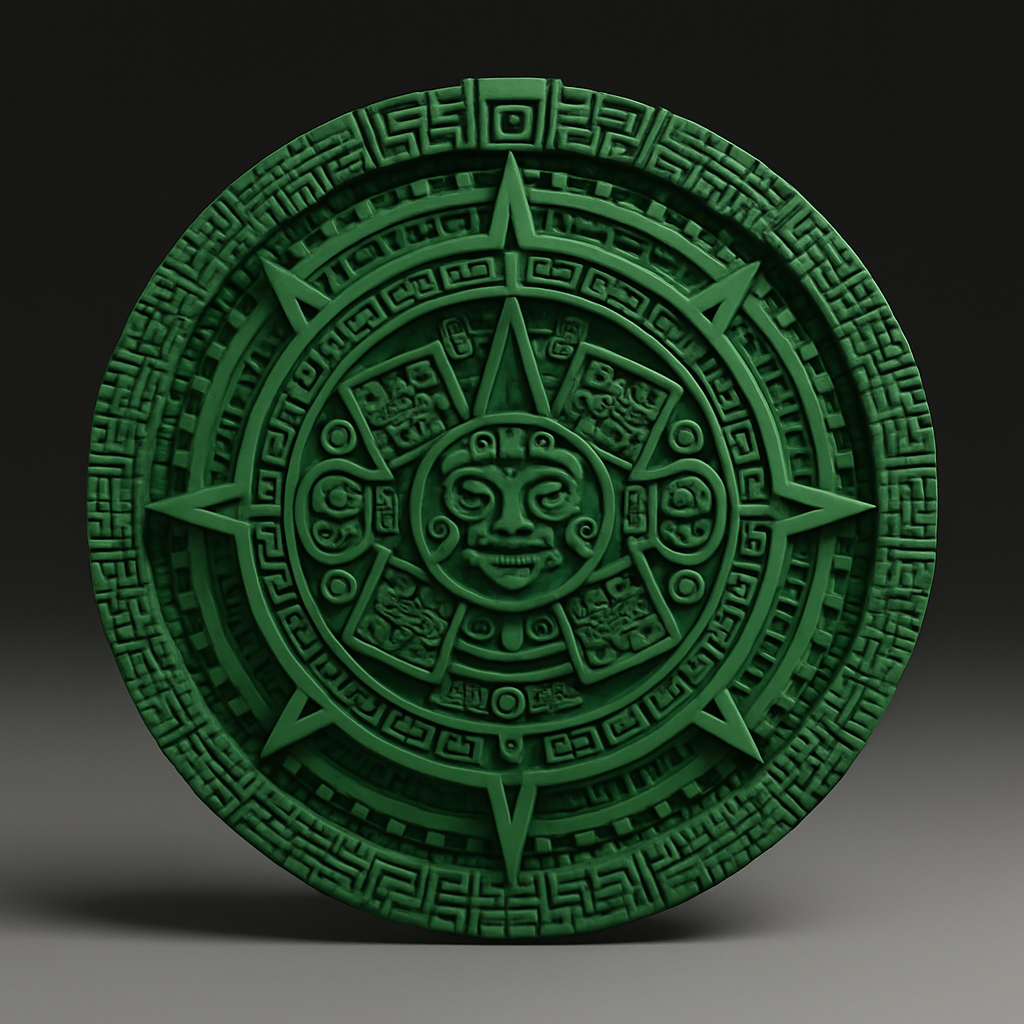
This is essentially what i saw in my vision, with the inner circles rotating in my mind. It was so subtle, but it was there.
What Might Be Happening?
I don’t know yet. But I sense that fascia, vibration, and intention might open subtle perception pathways — perhaps even those connected to visualization.
Maybe freeing fascia literally helps energy move through the sensory web that links body and consciousness.
Maybe those of us with aphantasia aren’t missing imagery — maybe it’s stored deeper, in the fascia, waiting for access through sensation rather than imagination.
How I’ll Continue
Over the next few weeks, I’ll keep journaling:
How my body feels (ease, tension, proprioception)
How my mind feels (clarity, imagery, intuition)
Any changes in the color, geometry, or feeling of inner vision
I’ll repeat fascia release, vibration work, and conscious movement — always safely and gently — and I’ll share what unfolds here.
Reflections
I’m not claiming science — just curiosity.
This is an experiment in listening: to my body, to the spaces between, to the possibility that consciousness has physical architecture.
Maybe the body’s connective tissue is also its connective knowing.
Maybe we can feel our way toward seeing.
This is Day One.
If you’d like to follow along as I explore the next steps — and perhaps try your own fascia-consciousness experiment — you can join my mailing list below.
Here’s to fluid networks, quiet visions, and the spaces where body and mind meet.
— Robin
Day Two
Today I leaned deeper into the rhythm of this experiment — not as a structured routine, but as a conversation with my body.
I began with dry brushing, this time with oil. My skin has been feeling a bit dry, so I slowed everything down, focusing on gentle, long strokes. I told myself I’d only do five minutes… but I found myself sinking into it. It felt nurturing, grounding, almost soothing in a way I wasn’t expecting. Ten minutes passed before I even looked at the time.
From there, I moved into rolling, again for ten minutes. The combination — dry brushing + rolling — is starting to feel like a way of waking up the fascia and getting the energy moving. I can sense certain lines or bands in my body that feel more “awake” than others, and I’m trying to meet those places with softness instead of force.
My loose plan is to eventually settle into a 10/10/10 rhythm:
10 minutes dry brushing
10 minutes rolling
10 minutes of Pilates
10 minutes of meditation
Today I actually reached that: ten minutes of each, although everything felt fluid and intuitive, not timed or rigid.
Before I moved into Pilates, I paused for sound — my tuning fork again. I focused especially on areas that feel like “problem spots”: my neck, my shoulder, my brow/third eye area. The vibration moves through me in a way nothing else does. It’s like a reset button for my nervous system, or a tuning of internal frequencies I don’t consciously understand but deeply feel.
Then I went to my reformer and let my body move without choreography. I couldn’t tell you what “exercises” I did — everything was slow, intentional, and responsive. I followed sensation. When something felt tight, I didn’t push into it — I lengthened around it, breathed into it, stretched through it. It felt like unwinding small knots that live in the corners of my fascia.
After the Pilates session, I went downstairs to meditate in the dark. I sat upright, closed my eyes, and started with the tuning fork again, moving it around my head, over my heart, behind my eyes, across my shoulder — anywhere that felt like it needed attention.
Then I added light pressure to my eyes.
Just like yesterday, I was in total darkness — no external light. At first my inner vision was black. But as soon as I applied pressure, I started seeing purple. It intensified when I looked upward under closed eyelids. The entire field of vision behind my eyes filled with a deep, saturated purple.
Then — when I released the pressure — the purple screen collapsed into a purple circle. That circle faded into green, and I’m fairly sure it shifted through blue, although it happened fast and I didn’t hold onto the details. The point is: I saw color again. In darkness. With no external stimulus.
It wasn’t imagination. It wasn’t a thought. It was perception — color emerging from within my visual field, just like yesterday’s emerald and geometry.
I don’t know what it means yet. I don’t know where it’s coming from. But two days in, and I’m witnessing internal colors and shifts in my inner landscape — something my aphantasic brain has never done voluntarily.
It feels like a beginning.
Day Three — Listening, Resting, and Letting the Words Speak
Today wasn’t a movement day — it was a listening day. I woke up sore, swollen, foggy, and honestly a bit sick. My throat hurt, my glands were tender, and everything from my ribs up felt tight and inflamed. Instead of pushing myself through my full fascia routine, I actually stopped and paid attention.
If this experiment is teaching me anything, it’s that listening counts.
Rest counts.
Slowing down counts.
So I did a gentle body scan, noticed the patterns (lower body fine, upper body overloaded), and chose not to force Pilates. I dry brushed, did a bit of rolling, and sat with my tuning fork for a short meditation.
No visuals came today — no colors, no geometry, nothing like the last two days. But something else happened.
Words started forming in my mind. Not thoughts… lines. Phrases. Almost rhythmic. So I opened my voice recorder and just started talking — because speaking out loud is one of the best ways for me to channel anything intuitive. When I talk, something unlocks. My voice knows how to open doors that my inner vision can’t.
And as I spoke, a poem poured out.
It wasn’t planned. It wasn’t forced. It just arrived — line by line, breath by breath — almost as if my fascia was communicating in a different language today. Not visuals. Not sensations. But words.
So even though today was softer, quieter, gentler… it still moved something.
Here is the poem that came through:
Fascia Knows
Give up everything you know
to go with the flow.
It knows what it knows.
It goes where it goes.
Without telling it twice,
it will wrap around and splice—
intuitively knowing
what your body needs,
what it needs to achieve.
It will tell you when something’s wrong,
when your body’s not strong.
It gives you advice—
it starts by asking you nice,
and then the challenges come along.
Your body is meant to feel strong,
not weak and diminished,
right until you’re finished.
The fascia says it all.
It’s not big, it’s so small,
yet it touches everything—
every human being and thing.
Fascia is fractal.
Fascia is smart.
Fascia is inherently coherent at heart.
It is where it starts and where it ends,
where we make connections
and loose ends.
If we ignore it for life,
it’s our biggest sacrifice—
because with that, you lose
an infinite muse,
the grower of all your hairs,
your heart, body, and soul.
It reminds us how we’re whole,
what connects us
to us all.
It unfolds
in every layer,
in every fractal,
in every sacred piece of geometry
that flows beneath
the inner knowing,
the inner glowing
that is within us all.
What goes ignored
could hold the potential—
the path to fascia flows,
fascia ways,
where to hold knowledge,
when to release pain.
But here we ignore.
We don’t listen.
It asks nicely at first—
then comes in with a burst
of anger,
of overwhelm,
of disconnected inspiration—
a flow that doesn’t know
where to stop
or when to grow.
We need to show
that we are willing to listen—
so we can grow,
so we can understand
our internal flow,
our internal glow
that’s been dimmed over time,
waiting to come back online.
Let’s listen to our fascia.
Your fascia knows.
It knows where to go.
It knows what it knows—
and it goes where it goes.